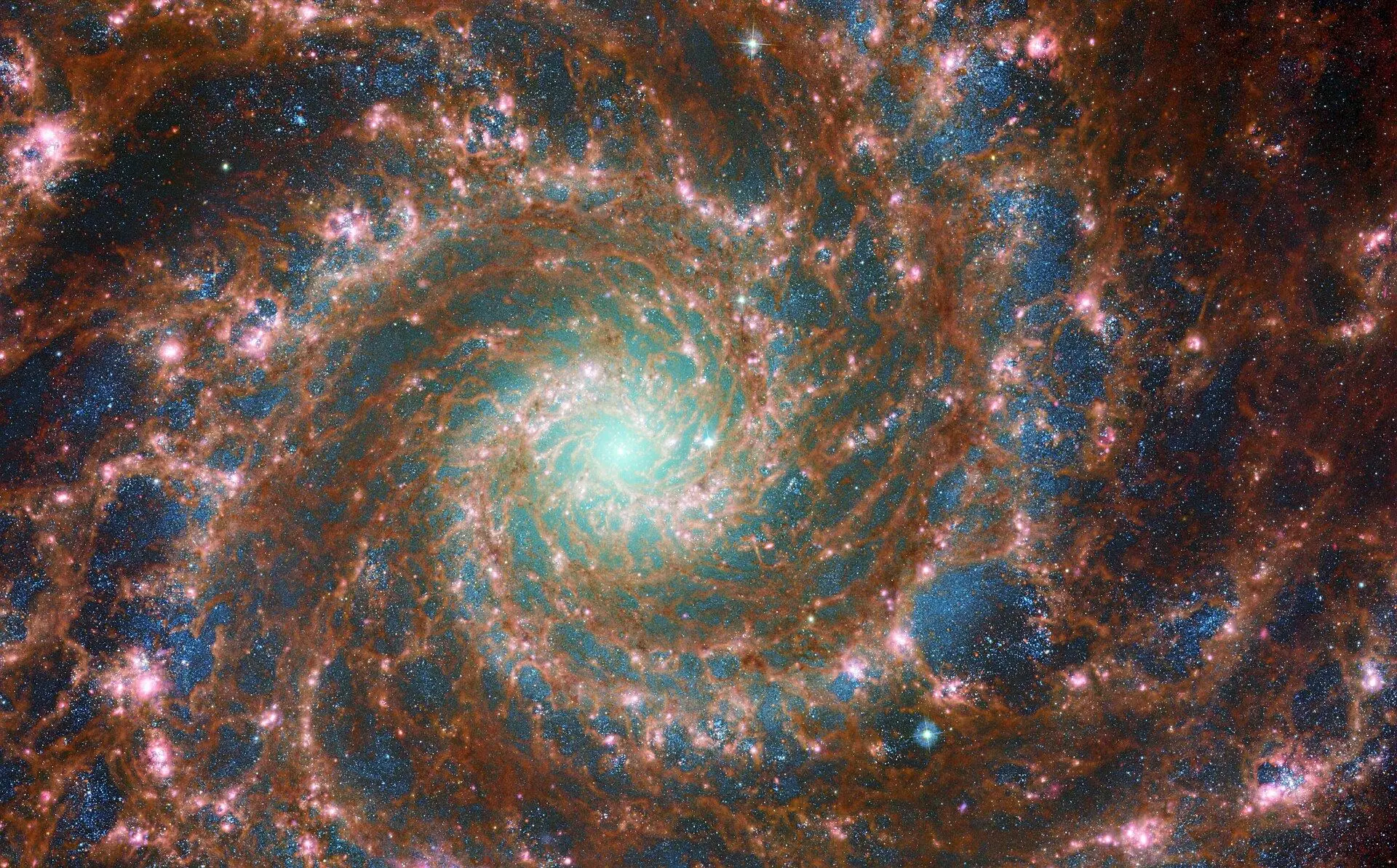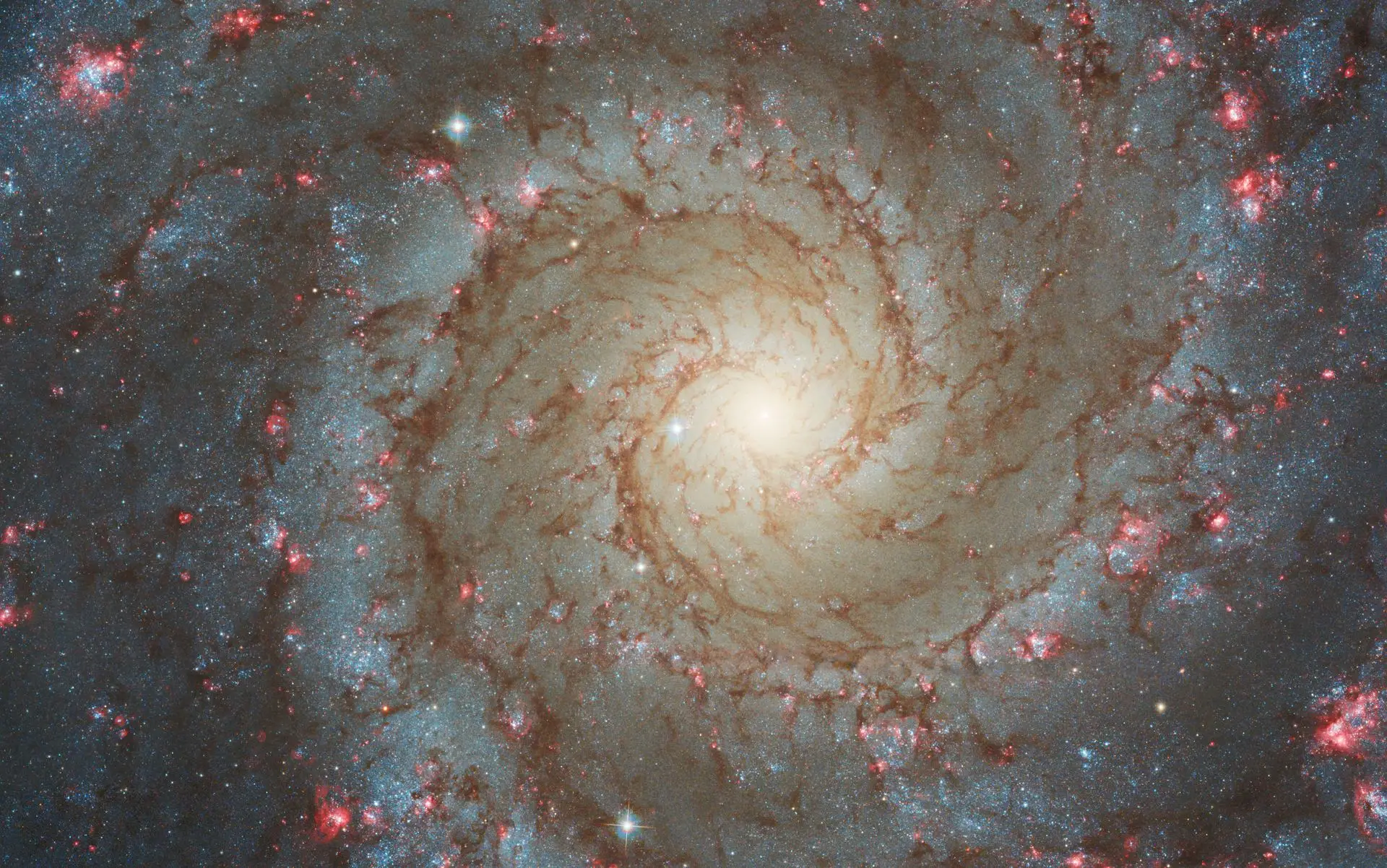
Face-on spiral galaxy, NGC 628, is split diagonally in this image: The James Webb Space Telescope’s observations appear at top left, and the Hubble Space Telescope’s on bottom right. Webb and Hubble’s images show a striking contrast, an inverse of darkness and light. Why? Webb’s observations combine near- and mid-infrared light and Hubble’s showcase visible light. Dust absorbs ultraviolet and visible light, and then re-emits it in the infrared. In Webb's images, we see dust glowing in infrared l.
Image: “Webb and Hubble’s Views of Spiral Galaxy NGC 628” by NASA, ESA, CSA, STScI, Janice Lee (STScI), Thomas Williams (Oxford), PHANGS Team, licensed Public domain, from Wikimedia Commons.
Credit and licence
- Creator
- NASA, ESA, CSA, STScI, Janice Lee (STScI), Thomas Williams (Oxford), PHANGS Team
- Licence
- Public domain
- Terms
- Public domain: no known copyright restrictions. Credit given as a courtesy.
- Source
- Wikimedia Commons
- Credit line
- “Webb and Hubble’s Views of Spiral Galaxy NGC 628” by NASA, ESA, CSA, STScI, Janice Lee (STScI), Thomas Williams (Oxford), PHANGS Team (Public domain), via Wikimedia Commons